
Why settle for a single data point when you can capture the entire cellular journey? Traditional endpoint assays often miss the critical dynamics of cell behavior. The Zencellowl transforms your incubator into a continuous discovery platform.
Our published research focuses on:
Precision Migration Assays: Instead of just seeing the final result, Zencellowl tracks the velocity and directionality of cell movement in real-time, providing deeper insights into wound healing and cancer research.
Dynamic 3D Growth: Observe how Spheroids and Organoids evolve. Our technology ensures that the structural integrity of 3D models is monitored without the stress of constant manual handling.
Performance Tracking: From initial seeding of adherent cells to long-term proliferation, we provide the data consistency required for high-throughput screening (HTS).
This study explores the potential of Xevinapant to sensitize Head and Neck Squamous Cell Carcinoma (HNSCC) to radiotherapy. Using the zenCELL owl, the researchers captured images every hour directly inside the incubator. This allowed for an uninterrupted observation of cell death and recovery phases over several days—data that conventional endpoint measurements would have missed.
Application: Long-term cell viability & Radiobiology
Technology: 24-channel automated microscopy
Focus: Synergistic drug-radiation effects
Potential upscaling protocol establishment and wound healing bioactivity screening of exosomes Sameri, S., et al. (2023). Turkish Journal of Veterinary & Animal Sciences, 47(3).
Key Insight: This study investigates the therapeutic potential of exosomes derived from mesenchymal stem cells for wound treatment. A critical part of the research involved a scratch assay to measure how these exosomes influence the speed of fibroblast migration. Using the zenCELL owl, the team performed continuous live-cell imaging to capture the exact kinetics of the wound closure.
Application: Automated Wound Healing & Migration Assays
Cell Type: Canine adipose-derived mesenchymal stem cells (cAD-MSCs) & Fibroblasts
Focus: Kinetic monitoring of gap closure rates
Mycolactone causes destructive Sec61-dependent loss of the endothelial glycocalyx and vessel basement membraneHsieh, L. T. H., et al. (2023). bioRxiv / eLife.
Key Insight: This study identifies a new mechanism for tissue necrosis in Buruli ulcer disease. The researchers used the zenCELL owl to perform high-resolution, long-term monitoring of primary vascular endothelial cells. The automated imaging captured how the toxin Mycolactone induces cell rounding, loss of adhesion, and a significant defect in cell migration. This kinetic data was crucial to proving that external supplementation of laminin-511 could partially restore cell attachment and migration.
Application: Real-time Migration Assays & Morphological Analysis
Cell Type: Primary Human Dermal Microvascular Endothelial Cells (HDMECs)
Technology: Continuous in-incubator monitoring of phenotypic changes
Chitosan-Based Nanofibers Loaded with Curcumin: A Novel Strategy for Enhanced Wound Healing Salehi, S., et al. (2023). Nanomaterials, 13(2), 330.
Key Insight: This research demonstrates how specialized nanofibers can accelerate the healing process. The zenCELL owl was instrumental in conducting a 72-hour continuous proliferation assay. Unlike manual microscopy, the automated system captured the exact kinetics of how human dermal fibroblasts interact with the scaffold, providing high-resolution data on cell density and attachment without removing the plates from the incubator.
Application: Kinetic Proliferation & Migration Assays
Cell Type: HDF (Human Dermal Fibroblasts)
Technology: 72-hour automated live-cell tracking
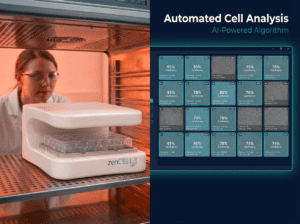
Watch zenCELL owl image live inside an incubator. Available.