
Why settle for a single data point when you can capture the entire cellular journey? Traditional endpoint assays often miss the critical dynamics of cell behavior. The Zencellowl transforms your incubator into a continuous discovery platform.
Our published research focuses on:
Precision Migration Assays: Instead of just seeing the final result, Zencellowl tracks the velocity and directionality of cell movement in real-time, providing deeper insights into wound healing and cancer research.
Dynamic 3D Growth: Observe how Spheroids and Organoids evolve. Our technology ensures that the structural integrity of 3D models is monitored without the stress of constant manual handling.
Performance Tracking: From initial seeding of adherent cells to long-term proliferation, we provide the data consistency required for high-throughput screening (HTS).
Long-term label-free monitoring of endothelial cell migration and morphology Hsieh, Y.H., et al. (2023). eLife (Reviewed Preprint 86931).
Key Insight: Endothelial cells (ECs) are central to vascular health and wound healing. This study establishes a robust method for monitoring EC behavior over long periods without the need for fluorescent markers or dyes, which can alter cell physiology. By utilizing label-free live-cell imaging (similar to the zenCELL owl setup), the authors quantified:
Migration Velocity: How fast ECs move in response to stimuli.
Morphological Changes: Dynamic shifts in cell shape during the formation of vascular-like structures.
Wound Closure: Real-time tracking of “healing” in a scratch assay model.
The findings highlight that automated, non-invasive imaging is superior for capturing the nuanced, multi-day processes of vascular development compared to traditional endpoint measurements.
Application: Vascular Biology, Angiogenesis, Drug Screening.
Cell Types: HUVEC (Human Umbilical Vein Endothelial Cells).
Technology: Label-free Live-Cell Imaging, Automated Tracking.
The potential of remdesivir to affect function, metabolism and proliferation of cardiac and kidney cells in vitroMerches, K., et al. (2022). Archives of Toxicology, 96(8).
Key Insight: This comprehensive study investigated the safety profile of Remdesivir on heart and kidney models. Using the zenCELL owl for live-cell monitoring, the researchers made a crucial discovery: the observed reduction in cell numbers at clinically relevant concentrations was primarily due to the inhibition of cell proliferation, rather than acute cell death (necrosis/apoptosis). The system allowed for dynamic observation of H9c2 cells, proving that Remdesivir interferes with the cell cycle and mitochondrial oxygen consumption.
Application: Drug Safety & Toxicology (Cardio/Nephro)
Cell Types: H9c2 (Cardiomyoblasts), NMCM, RPTEC/TERT1, NRK-52E
Technology: Live cell imaging (zenCELL owl), Seahorse Metabolic Profiling, Proteomics.
Anti–phagocytosis-blocking repolarization-resistant membrane-fusogenic liposome (ARMFUL) for adoptive cell immunotherapy Zheng, C., et al. (2023). Science Advances, 9(32).
Key Insight: This research introduces a “core-shell” liposome platform that uses membrane fusion to engineer immune cells in a single step. By fusing with M1 macrophages, ARMFUL simultaneously anchors anti-CD47 to the cell surface (to boost tumor eating/phagocytosis) and releases a CSF1R inhibitor (BLZ945) into the cytoplasm (to prevent the cell from turning into a pro-tumor M2 state). This dual-action approach significantly improved antitumor efficacy in solid tumor models.
Application: Adoptive Cell Therapy (ACT) & Solid Tumor Immunotherapy
Innovation: One-step synchronous engineering of intracellular and extracellular targets.
Focus: Membrane-fusogenic liposomes (ARMFUL) for macrophage remodeling.
Analysis of Cytotoxic Effect using the Live Cell Imaging System Zeng, X. & Chen, Y. (2022). International Core Journal of Engineering, 8(8).
Key Insight: This study validates the zenCELL owl as a reliable alternative to traditional endpoint assays (like MTT/CCK-8). By capturing images every 30-60 minutes, the researchers could pinpoint exactly when H2O2 and Doxorubicin began to induce morphological changes and cell death. The study emphasizes the system’s ability to provide marker-free, automated quantitative analysis of cell density and proliferation directly inside the incubator, avoiding the risk of false-positive results.
Application: Cytotoxicity & Oxidative Stress Monitoring
Cell Types: 293T cells & Cardiac Microvascular Endothelial Cells (CMECs)
Technology: 24-channel automated remote monitoring (zenCELL owl)
Individual and Combined Cytotoxic Effects of Mycotoxins on Spheroids and 2D Cultures Ferreira, S., et al. (2023). Toxins, 15(6), 384.
Key Insight: This study highlights the critical difference between 2D and 3D cell models in toxicology. Using the zenCELL owl, the researchers monitored the growth and viability of Caco-2 spheroids over 48 hours. The automated imaging allowed for a precise, non-invasive evaluation of how various toxins impact the structural integrity and performance of complex 3D micro-tissues.
Application: 3D Spheroid Monitoring & Cytotoxicity
Cell Type: Caco-2 (Human colorectal adenocarcinoma)
Technology: Continuous 24-channel imaging for 3D models
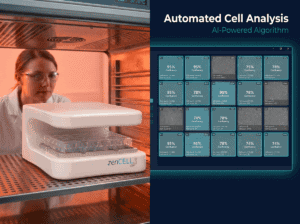
Watch zenCELL owl image live inside an incubator. Available.