
Why biological inputs should be part of experimental design discussions
“`html
Why Biological Inputs Should Be Part of Experimental Design Discussions
The Critical Role of Biological Inputs in Research
Understanding Biological Variability
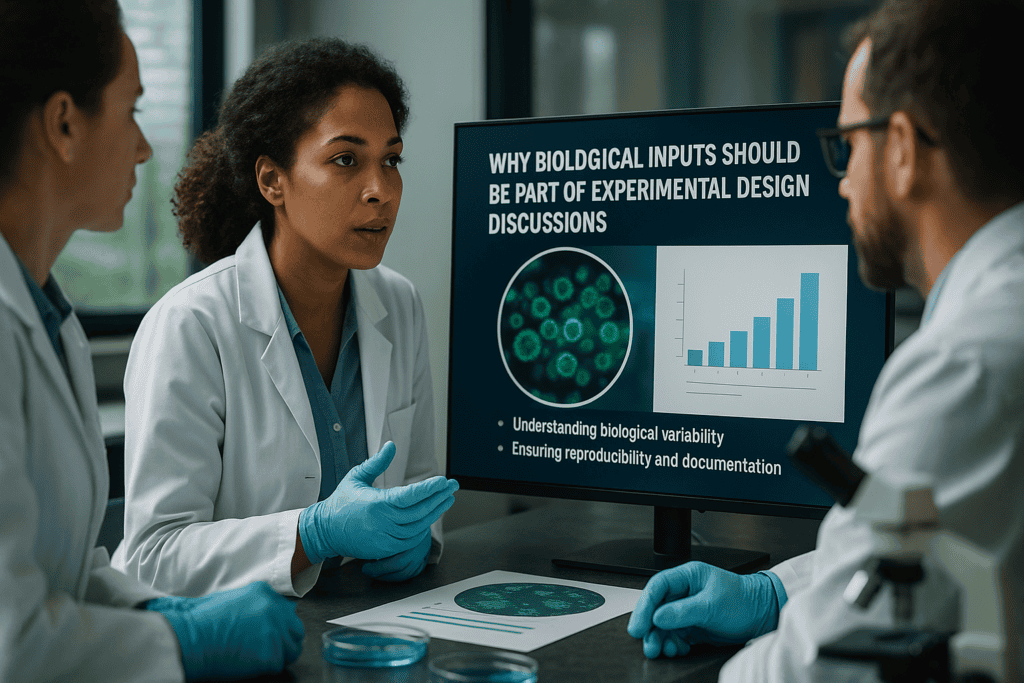
Biological inputs, such as sera and plasma, significantly influence the outcomes of cell culture experiments. These materials inherently carry biological variability due to factors such as donor differences and lot-to-lot changes, potentially affecting the reproducibility of results. Understanding and acknowledging this variability is essential when designing experiments.
- Recognizing biological variability is crucial for accuracy and reliability.
- Lot-to-lot variability requires comprehensive documentation and consistent sourcing.
Continue reading to explore more advanced insights and strategies.
Incorporating Quality Control in Experimental Design
Ensuring Reproducibility and Documentation
The incorporation of stringent quality control measures is critical when utilizing biological inputs. An essential strategy involves thorough documentation and consistent testing, aligning with protocols for reproducibility. Utilizing resources like those available at SeamlessBio can aid researchers in accessing well-documented sera and reagents.
- Quality control processes minimize experimental variability.
- Proper documentation supports reproducibility and peer review.
Continue reading to explore more advanced insights and strategies.
Biological Inputs and Their Functional Roles
Biological Functions and Applications
Animal-derived biologicals, such as Fetal Bovine Serum (FBS), play critical roles in cell culture media, aiding in cell growth and maintenance by providing essential hormones and nutrients. Human-derived biologicals are also integral for research into human health and diseases, particularly when ethical considerations and donor variability are managed effectively.
- Different biological inputs cater to varied research applications.
- Consideration of functional roles enhances experimental outcomes.
Continue reading to explore more advanced insights and strategies.
Addressing Ethical and Regulatory Considerations
Ethical Sourcing and Compliance
It is imperative to ensure that biological inputs are sourced ethically and comply with regulatory frameworks. This consideration not only aligns with ethical research practices but also elevates the standard of research outcomes. Researchers can benefit from resources such as Innome for ethically sourced cell culture materials.
- Adhering to ethical standards is crucial for valid scientific inquiries.
- Regulatory compliance safeguards the integrity of research data.
Continue reading to explore more advanced insights and strategies.
Advanced Monitoring and Project Stability
Continuous Monitoring and Data Documentation
Innovative technologies, like the incubator-compatible live-cell imaging systems, are revolutionizing the way experiments are monitored. Systems such as the zenCELL owl enable continuous visualization and documentation of cell behavior, thereby facilitating improved reproducibility and long-term project stability.
- Continuous monitoring enhances data accuracy and project stability.
- Advanced imaging technologies support comprehensive documentation.
Continue reading to explore more advanced insights and strategies.
“`
“`html
Leveraging Technological Innovations for Enhanced Research Outcomes
Adopting Cutting-edge Technologies
Technological advancements in life sciences are driving considerable improvements in data accuracy and efficiency. By integrating tools such as CRISPR gene-editing, AI-driven analytics, and automated systems, researchers can address limitations associated with human error, enhancing precision in experimental designs. For instance, AI-powered systems can efficiently manage and analyze large datasets, revealing insights that might be overlooked in human-driven analyses.
- Integrate AI and automation for data handling and analysis to enhance precision.
Creating Standard Operating Procedures (SOPs) for Consistency
Strategies for Developing Effective SOPs
Developing meticulous Standard Operating Procedures (SOPs) is crucial for maintaining consistency and reliability across research projects. By establishing detailed guidelines, researchers can ensure repeatability and compliance with regulatory standards. SOPs should be regularly reviewed and updated to incorporate the latest scientific discoveries and technological advancements.
- Regularly update SOPs to reflect new research findings and innovations.
Implementing Integrated Data Management Systems
The Role of LIMS in Data Tracking
Laboratory Information Management Systems (LIMS) offer a robust solution for efficient data management and tracking. Utilizing LIMS, researchers can streamline experiment data handling, right from collection to analysis. A case study involving the University of California revealed that adopting LIMS reduced data redundancy and improved collaborative efforts across multiple departments.
- Select LIMS platforms that align with specific research needs to maximize benefits.
Utilizing Multidisciplinary Approaches
Cross-Disciplinary Collaboration in Research
Interdisciplinary approaches integrate knowledge from different fields, enhancing the complexity and applicability of research findings. Collaborations between biochemists, data scientists, and engineers, for instance, are yielding innovative solutions to longstanding biological queries. An example includes combining mathematical models with biological data to better understand disease pathways.
- Foster partnerships across various disciplines for enriched research outcomes.
Optimizing Experimental Conditions
Environmental Control and Monitoring
Optimizing the physical and chemical environment where experiments are conducted is essential for accurate data. Environmental control technologies that regulate temperature, humidity, and CO2 levels within labs have proven to safeguard experiment integrity. Research undertaken by NASA has demonstrated that well-controlled environments significantly reduce the variability in experimental outcomes.
- Implement dynamic environmental controls to stabilize experimental settings.
Harnessing Big Data and Computational Models
Transforming Data into Actionable Insights
With the surge in data availability, leveraging big data analytics and computational models is transforming the biological research landscape. Sophisticated algorithms enable the processing of vast datasets to discern patterns, predict outcomes, and inform experimental improvements. In cancer research, for instance, big data analysis has been pivotal in identifying genetic mutations and potential drug targets.
- Incorporate big data tools to gain deeper insights and refine research approaches.
Enhancing Experimental Design through Simulation
Virtual Experiments and Predictive Modeling
Simulation and predictive modeling allow researchers to test hypotheses in silico before conducting real-world experiments. This method can significantly reduce costs and resource expenditure while enhancing understanding of potential outcomes. Researchers at the Massachusetts Institute of Technology have successfully used simulations to predict cellular responses to therapeutic interventions, optimizing drug development processes.
- Leverage simulation tools to predict experimental outcomes and optimize designs.
Engaging Stakeholders in Research Processes
Collaborative Approaches to Research Design
Engaging stakeholders—including funders, ethicists, and community representatives—early in the research process can enhance transparency, ethics, and public trust. Collaborative design processes ensure that research questions align with societal needs, increasing the relevance and impact of scientific endeavors. A multi-institutional collaboration in the UK exemplified this approach, harmonizing research objectives with public health priorities.
- Build stakeholder engagement into research timelines to strengthen project relevance.
Next, we’ll wrap up with key takeaways, metrics, and a powerful conclusion.
“`
“`html
Focusing on Ethical Considerations in Research
Balancing Innovation with Responsibility
In the pursuit of scientific advancement, ethical considerations must not be overshadowed by technological innovations. Ensuring that research methodologies adhere to ethical standards is critical for the credibility and societal acceptance of scientific findings. Researchers should integrate ethical reviews throughout the research process, establishing transparency and accountability. Implementing comprehensive ethical guidelines can help safeguard against potential biases and reduce the risk of harm.
- Regularly conduct ethical audits to ensure research aligns with societal and moral standards.
Integrating Open Science Practices
Driving Research through Transparency
Adopting open science practices is becoming increasingly important as a means to facilitate collaboration and promote transparency. Open science encourages the sharing of data and research methodologies, allowing for broader peer evaluation and validation of results. The Human Genome Project is a prominent example where open data-sharing led to accelerated discoveries and advancements in genomics. By fostering an open-access environment, researchers can drive innovation while maintaining integrity in their scientific pursuits.
- Promote data sharing and collaborative platforms to enhance innovation and reproducibility.
Enhancing Communication of Research Findings
Improving Public Understanding and Engagement
Effectively communicating research findings is fundamental to bridging the gap between science and society. Researchers should prioritize clarity and accessibility in their dissemination of information, ensuring that non-experts can understand the implications of their work. Utilizing diverse media platforms and visual aids can enhance public engagement and stimulate interest in scientific developments. Successful communication strategies not only foster public support but also inspire the next generation of scientists.
- Utilize clear communication strategies to translate complex research into accessible information.
Conclusion
This comprehensive exploration underscores the indispensable role of integrating technological advancements, ethical considerations, and cross-disciplinary collaborations in enhancing research outcomes in the life sciences. By embracing innovations such as AI in data analysis and CRISPR in gene-editing, researchers can significantly boost the precision and efficiency of experimental designs. Furthermore, by developing robust SOPs, implementing sophisticated LIMS, and optimizing experimental conditions, the potential for meaningful scientific breakthroughs is greatly enhanced.
The establishment of ethical standards and the adoption of open science practices offer a solid foundation for conducting responsible research. These measures ensure not only the credibility of scientific endeavors but also their alignment with societal needs. As we’ve seen from significant initiatives like the Human Genome Project, open data sharing can expedite progress and cultivate an inclusive research environment.
Ultimately, the integration of transparent communication methods completes the research spectrum, ensuring that scientific insights are effectively conveyed to the public. This enables a broader understanding of scientific advancements and their implications, fostering societal trust and engagement. For researchers and institutions, it’s vital to not only conduct groundbreaking research but also ensure these findings translate into actionable societal benefits.
In taking these strategic measures, the life sciences community is better equipped to tackle complex scientific questions and contribute to the advancement of knowledge and improvement of human health. As we move forward, let us remain committed to pushing the boundaries of science with innovation, integrity, and a collaborative spirit. I encourage researchers across disciplines to actively engage in these forward-thinking strategies, paving the way for a future where scientific discoveries seamlessly translate into impactful solutions for the world’s pressing challenges.
“`