This guide explains what you actually need for continuous in-incubator brightfield imaging, what it costs, and how to get started.
What You Actually Need vs. What You Think You Need
The gap between what researchers think live cell imaging requires and what most applications actually need is significant. Here is the honest breakdown:
What most labs think they need:
- Multi-channel fluorescence (brightfield + 2–4 fluorescence channels)
- High-throughput 96-well or 384-well scanning
- Sub-cellular resolution imaging
- Integrated environmental control with dedicated incubator
- Software with pre-built assay modules for every application
What most labs actually need for their primary applications:
- Brightfield imaging — sufficient for wound healing, confluency, morphology, neurites, spheroids
- 24-well plate format — covers the vast majority of standard assays
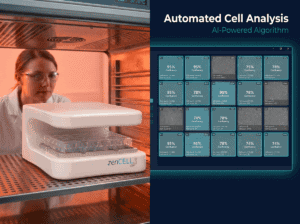
- Continuous time-lapse inside the existing incubator
- Automated confluency and gap closure analysis
- CSV export for Prism or Excel
The Real Cost Comparison
Traditional HCS system — 5 year total cost
zenCELL owl — 5 year total cost
Applications Where zenCELL owl Replaces Expensive Systems
Scratch & Wound Healing Assays
Full kinetic wound closure data in 24 wells simultaneously. Gap area, closure rate, t½ — all calculated automatically. No transport, no disturbance.
Überwachung von Konfluenz
Automated % confluency per well at every timepoint. Know exactly when to treat, passage, or image — without guessing.
Cytotoxicity & Cell Viability
Morphological changes from compound addition visible in real time. Confluency decline as proxy for cell loss — no metabolic assay reagent needed.
PC12 & Neuronal Differentiation
Neurite outgrowth in brightfield over 24–72 hours. No phototoxicity risk, no fluorescent labelling, full kinetic differentiation curve.
Spheroid Growth Monitoring
Diameter, compactness, and necrotic core formation monitored continuously. Long-term 3D culture observation without incubator disturbance.
Cell Morphology & Culture Health
Continuous observation of any adherent cell culture. Contamination detected 6–12h early. Recovery after passaging documented automatically.
What You Still Need an Expensive System For
Be clear about when you genuinely need a high-content system:
- Multikanalfuoreszenz — GFP/RFP reporters, immunofluorescence, ion sensors
- 384-well high-throughput screening — drug discovery at scale requiring hundreds of conditions
- Sub-cellular resolution — organelle tracking, cytoskeletal dynamics at high magnification
If none of these apply to your primary applications, you are paying for capability you do not use.
How to Get Started
- Book a free demo — 30 minutes via MS Teams, real cells, your questions answered
- Start with the Starter Kit — ScratchMaker Plates for your first standardized wound healing assay while you evaluate the system
- Leasing below procurement threshold — order directly without waiting for equipment application approval
- Setup in 10 minutes — USB-C, place in incubator, start imaging
30-min demo — see it in your application
Real cells, real incubator. Tell us your application and we show you exactly what you would see.
Häufig gestellte Fragen
Is zenCELL owl validated for publication?
Yes — zenCELL owl has been cited in 50+ peer-reviewed publications across cell biology, pharmacology, and biomedical research journals. The system was originally developed at the University of Regensburg and licensed from Fraunhofer EMFT, providing an academic validation foundation that most lab-built alternatives lack.
Can I use zenCELL owl data in a grant application?
Yes. Data generated with zenCELL owl is publication-quality and has been included in grant applications for DFG, BMBF, and EU Horizon projects. We provide technical documentation and specification sheets in formats required by grant offices.
What if I need fluorescence in the future?
zenCELL owl handles brightfield applications. If you later need fluorescence imaging, you can run brightfield experiments with zenCELL owl while using your shared fluorescence microscope for specific fluorescent readouts — the two approaches complement each other. zenCELL owl does not replace your fluorescence infrastructure; it handles all brightfield-compatible applications independently.