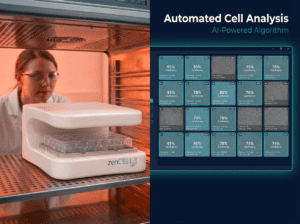
In-Incubator Microscopy · Pricing · AlternativesIf you have ever looked up the price of an in-incubator live cell imager, you already know the problem. The systems that exist are powerful — and expensive. Most labs end up sharing one device between 10 or 20 researchers, booking slots days in advance, and missing the biology that happens between scheduled timepoints.
But the question most researchers never get a good answer to is: is there a cheaper option? This article answers that directly.
Quick AnswerzenCELL owl by innoME GmbH is currently the most affordable in-incubator live cell imager available — leasing from €290/month, no annual licence fee, software included. It images all 24 wells simultaneously in brightfield inside any standard CO₂ incubator. Compared to traditional in-incubator HCS systems, it delivers in-incubator imaging at a fraction of the cost for labs that do not require fluorescence.
Why In-Incubator Microscopes Are Expensive — and Why Most Labs Can’t Afford One
The scientific literature is clear on the problem. A 2026 bioRxiv preprint from UC Santa Cruz states it directly: “existing solutions are often constrained by the cost, footprint, and inflexibility of in-incubator microscopes.” This has been true for over a decade — and it is why most cell biology labs still use manual microscopy at fixed timepoints despite the well-documented limitations.
The dominant in-incubator HCS systems are designed for pharmaceutical and high-throughput screening environments. Their price points reflect that. For an academic lab with a €50,000 annual equipment budget, a single in-incubator system can consume a significant portion of the allocation — and may still require annual licence fees on top.
The Three Categories of In-Incubator Imaging Systems
Category 1 — High-content screening systems (contact manufacturer for pricing)
Leading in-incubator HCS systems. Full fluorescence, high throughput, multiple plate formats. Designed for pharma and large core facilities. Annual licence fees typically required. Not practical for most academic labs as a dedicated per-researcher device.
Category 2 — Stage top incubators + existing microscope
ibidi Stage Top Incubators, Okolab, Tokai Hit. These attach to your existing microscope and maintain temperature and CO₂ at the stage. Lower cost than Category 1, but require transport of cells from incubator to microscope — and image one position at a time. Not truly “in-incubator.”
Category 3 — True in-incubator brightfield imagers
zenCELL owl. Sits inside your existing CO₂ incubator. Images all 24 wells simultaneously. No fluorescence — brightfield only. No transport. No annual fees. This is the category that has been missing from the market and that most researchers ask about when they say “is there a cheaper option?”
Honest Comparison: zenCELL owl vs. Traditional HCS System
| Criterion | zenCELL owl | Traditional HCS System |
|---|---|---|
| Prix | Leasing on request · Purchase on request | Contact manufacturer for pricing |
| Frais de licence annuels | €0 — software included perpetually | Annual licence typically required — contact manufacturer |
| Location | Inside your existing CO₂ incubator | Dedicated incubator required |
| Imaging modality | Brightfield (5MP) | Brightfield + fluorescence |
| Wells simultaneously | 24 — true parallel | Sequential scanning |
| Fluorescence | Not available | Yes — multi-channel |
| Setup | Plug & Play — USB-C — 10 min | Installation and calibration required |
| Procurement | Below threshold — researcher orders directly | Full procurement process required |
| Publications | 50+ peer-reviewed | Extensive library |
When zenCELL owl Is the Right Choice
- Your primary applications are brightfield: wound healing, confluency, cytotoxicity, spheroids, morphology
- You do not require multi-channel fluorescence imaging
- Budget constraints make traditional HCS systems impractical
- You want one device per researcher — not a shared system with a booking queue
- Your institution’s procurement threshold makes leasing at €290/month the fastest path to imaging
When You Still Need a High-Content System
- Your assay requires fluorescence imaging — GFP/RFP reporters, immunofluorescence
- You need 96-well or 384-well plate scanning for HTS applications
- Your core facility serves 50+ researchers across multiple departments
Note sur la fluorescence : For wound healing assays, confluency monitoring, cytotoxicity, PC12 differentiation, spheroid growth, and barrier integrity monitoring, brightfield imaging provides all necessary information. Fluorescence is only required when imaging specific molecular targets. If you are unsure whether your application requires fluorescence, book a free consultation — in most cases, brightfield is sufficient.
See zenCELL owl — free 30-min demo
Real cells, real incubator, your questions answered live. No obligation.
Foire aux questions
Is zenCELL owl a replacement for traditional in-incubator HCS systems?
For brightfield-only applications — yes, completely. For fluorescence applications, no — zenCELL owl does not support fluorescence imaging. Most wound healing, confluency, cytotoxicity, and morphology assays run entirely in brightfield and do not require fluorescence capability.
What is included in the zenCELL owl leasing price?
The leasing includes the full zenCELL owl system, software with all analysis modules (confluency, gap closure, morphology), firmware updates, and technical support. There is no additional annual licence fee. The only recurring cost is the monthly leasing payment.
Can I purchase zenCELL owl instead of leasing?
Yes — outright purchase is available. Contact info@zencellowl.com for a formal quote suitable for procurement applications, grant submissions, or equipment budgets.