“`html
Why Analytical Specifications Alone Do Not Guarantee Functional Performance
Analytical Specifications: The Basics
Quantitative vs. Qualitative Assessments
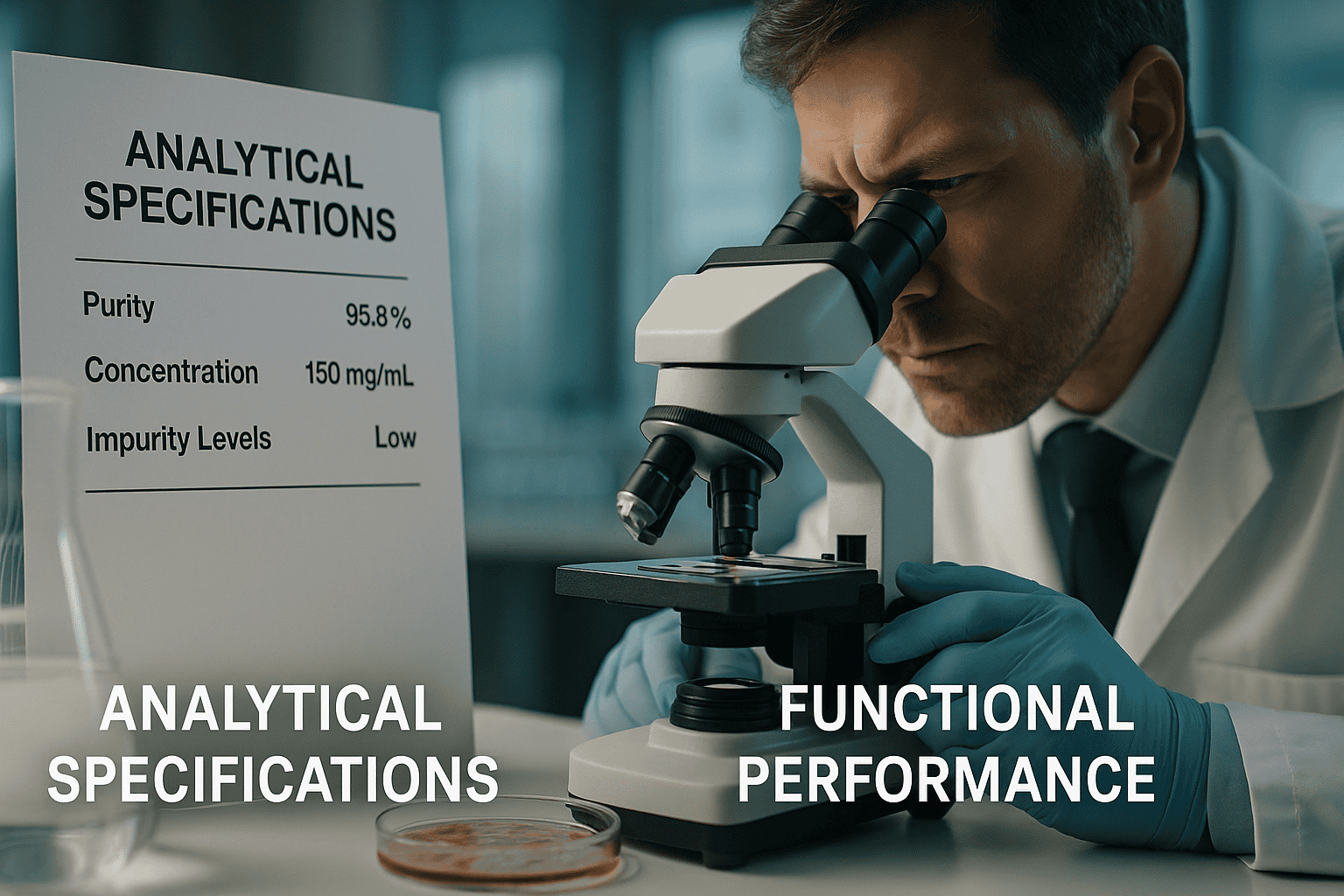
Analytical specifications often comprise quantitative metrics that describe a product’s chemical composition, purity, and concentration. These parameters are vital in determining batch consistency for materials such as Fetal Bovine Serum (FBS) and human plasma. However, quantitative assessments alone cannot capture the full scope of functional capabilities.
- Quantitative metrics offer precision but lack insight into functional variability.
- Qualitative assessments highlight the suitability of materials for specific applications.
继续阅读,以探索更深入的见解和策略。.
The Role of Biological Variability in Functional Performance
Understanding Lot-to-Lot Variability
Lot-to-lot variability in animal-derived biologicals like FBS can significantly impact experimental outcomes. While analytical specifications might indicate identical chemical profiles, biological variability can influence cell culture behaviors. Factors such as animal diet and environmental conditions contribute to this variability.
- FBS from different lots may exhibit different growth-promoting activities.
- Addressing variability is crucial for reproducibility in cell culture experiments.
继续阅读,以探索更深入的见解和策略。.
The Importance of Functional Testing
Beyond Analytical Specifications
Functional testing assesses real-world biological activity. This involves evaluating the effects of serums or reagents on cells, tissues, or organisms. While analytical specifications provide a static snapshot, functional tests demonstrate dynamic interactions and effects.
- Testing functional performance reveals how products behave in biological systems.
- Integrated functional testing can guide successful application in research workflows.
继续阅读,以探索更深入的见解和策略。.
Documentation, Traceability, and Risk Management
Ensuring Consistency and Reliability
Comprehensive documentation and traceability of biological materials are fundamental to risk management. These practices support transparency and auditability, allowing researchers to verify the origins and handling of materials. Platforms like shop.seamlessbio.de offer insights into sourcing and specifications of sera and reagents.
- Accurate documentation minimizes risks associated with batch variability.
- Traceability enhances the quality assurance of biological materials.
继续阅读,以探索更深入的见解和策略。.
Continuous Monitoring of Cell Behavior
Utilizing Live-Cell Imaging Systems
Real-time monitoring technologies, such as incubator-compatible live-cell imaging systems, like the zenCELL owl, offer invaluable insights into cell behavior. These tools allow researchers to observe the functional impacts of varied serum or reagent conditions over extended periods, thereby improving the reproducibility of long-term experiments.
- Continuous monitoring provides a dynamic view of cellular responses.
- Documentation enhances understanding of experimental variables’ impacts.
继续阅读,以探索更深入的见解和策略。.
“`
“`html
Implementing Standardized Protocols
Reducing Experimental Variability
To ensure consistency across experiments, establishing standardized protocols is essential. By defining clear parameters for each phase of the experimental process, researchers can minimize variables that might affect outcomes. This approach is particularly useful when working with complex biological systems, where even minor deviations can have significant impacts.
- Develop detailed standard operating procedures (SOPs) for experiments.
- Regularly review and update protocols to incorporate the latest research findings.
Advanced Quality Control Techniques
Enhancing the Verification Process
Incorporating advanced quality control techniques into laboratory workflows can further bridge the gap between analytical specifications and functional performance. Techniques such as mass spectrometry and high-performance liquid chromatography (HPLC) can be used to verify the consistency and purity of biological materials. These methods offer more in-depth analysis than standard assays and can highlight potential discrepancies.
- Utilize mass spectrometry for detailed molecular composition analysis.
- Apply HPLC to verify the purity and concentration of substances.
Leveraging Machine Learning for Predictive Insights
Harnessing Data for Better Predictions
Machine learning algorithms can process vast amounts of data to predict outcomes and identify trends that might not be immediately apparent from analytical data alone. By analyzing historical data on material performance and laboratory conditions, predictive models can provide insights into potential functional performance, thereby assisting in decision-making processes.
- Create machine learning models to analyze historical performance data.
- Use predictive insights to optimize experimental design and material selection.
Building a Cross-Functional Research Team
Integrating Diverse Expertise
A cross-functional research team that includes experts in biology, chemistry, data science, and engineering can offer diverse perspectives and problem-solving approaches. This collective expertise is invaluable in tackling the multifaceted challenges of ensuring functional performance. Collaboration promotes innovation and can lead to the development of new methodologies and technologies.
- Foster interdisciplinary collaboration to enrich research approaches.
- Encourage team members to share knowledge and techniques.
Creating a Biobank of Referenced Materials
Establishing Baselines for Comparative Studies
A comprehensive biobank that houses a range of well-characterized materials serves as a valuable resource for comparative studies. By maintaining consistent reference standards, researchers can more accurately gauge functional variability and establish predictive models. This approach also supports reproducibility by ensuring access to identical materials over long periods.
- Develop a curated biobank for long-term research consistency.
- Ensure all biobank entries are carefully documented and traceable.
Applying Blockchain for Transparent Supply Chains
Enhancing Material Traceability and Trust
Blockchain technology offers enhanced transparency and traceability in the supply chains of biological materials. By recording each step in the material handling process on an immutable ledger, researchers and suppliers can ensure the authenticity and integrity of reagents. This transparency builds trust and can mitigate risks associated with material discrepancies.
- Implement blockchain solutions to improve traceability and verification.
- Engage with suppliers who use transparent supply chain technologies.
Utilizing Digital Twins for Experimental Optimization
Simulating Real-World Scenarios Virtually
Digital twins serve as virtual replicas of physical processes, enabling researchers to simulate and analyze potential experimental outcomes without physical trials. This technology can identify areas of potential risk, allowing for adjustments before actual experimentation. Digital twins enable risk-free testing of hypotheses, optimizing processes for better functional outcomes.
- Develop digital twins of laboratory environments to simulate experiments.
- Analyze simulated scenarios to improve experimental accuracy and efficiency.
Enhancing Reproducibility with Open Data Platforms
Fostering Community Collaboration
Open data platforms facilitate the sharing of research findings and methodologies, promoting transparency and reproducibility. By openly exchanging data and insights, researchers can validate findings and implement successful strategies from peer studies. This culture of cooperation accelerates advancements in ensuring functional performance and drives innovation in the life sciences field.
- Share findings and methodologies on open data platforms to enhance reproducibility.
- Engage in collaborations with the scientific community to expand research impact.
接下来,我们将总结要点、指标和一个有力的结论。.
“`
“`html
Integrating Ethical Considerations in Research
平衡创新与责任
As advancements in technology continue to propel research, integrating ethical considerations into experimental designs becomes paramount. Ethical frameworks ensure that scientific progress does not come at the cost of social responsibility or human welfare. Moreover, transparency in acknowledging the broader implications of research findings fosters public trust and acceptance.
- Incorporate ethical reviews in the initial stages of experimental planning.
- Maintain transparency with stakeholders about potential social and environmental impacts.
Ensuring Scalability in Experimental Designs
From Lab Bench to Larger Applications
As promising results emerge in laboratory settings, ensuring scalability becomes a critical consideration. Transitioning from small-scale experiments to larger applications requires meticulous planning and validation to maintain functionality. Identifying scalable techniques and methodologies from the outset facilitates smoother transitions to real-world applications, successfully translating research into practical and impactful solutions.
- Design experiments with scalability in mind, considering potential variables.
- Conduct pilot studies to validate scalability before full-scale deployment.
Future Perspectives on Functional Performance
Navigating Emerging Challenges and Opportunities
The landscape of functional performance research is continuously evolving, driven by technological advancements and emerging scientific insights. Future perspectives involve harnessing new tools and methodologies, such as quantum computing and bioinformatics, that promise to redefine analytical capabilities. Staying abreast of these developments will be crucial for researchers committed to pushing the boundaries of what is scientifically possible.
- Invest in ongoing education to keep pace with emerging technological advances.
- Engage with multidisciplinary networks to foster innovation and discover novel approaches.
结论
The journey through the comprehensive exploration of why analytical specifications alone do not guarantee functional performance has highlighted several critical strategies and insights. From implementing standardized protocols to embracing emerging technologies, each section has underscored the importance of a holistic approach in bridging the gap between analytical rigor and functional success. By reducing experimental variability, employing advanced quality control techniques, and leveraging predictive insights through machine learning, researchers can enhance the reliability of their findings.
Moreover, the integration of diverse expertise through cross-functional research teams and the establishment of biobanks and transparent supply chains contribute to more robust and reproducible research outcomes. Incorporating digital twins for experimental optimization and fostering community collaboration through open data platforms further enhance the scientific endeavor’s credibility and efficiency.
This article also cast a spotlight on the need for ethical considerations, scalability, and future perspectives in research methodologies. These insights emphasize not only the importance of technology and data but also the critical role of responsibility, adaptability, and foresight. The interdisciplinary and community-centric approaches covered here emphasize that the path to functional performance advancements is a collective pursuit, fueled by a synergy of innovation and ethical integrity.
As researchers and scientists move forward, embracing these strategies can foster an environment conducive to groundbreaking discoveries. We invite you to apply these insights and continue sharing your findings and methodologies to enrich the life sciences field. By doing so, you contribute to a global quest for knowledge where functional performance not only meets expectations but exceeds them, paving the way for a future where scientific precision goes hand in hand with impactful functionality.
“`