
Hypoxic cell culture imaging is technically the hardest live cell imaging application: cells must remain under reduced oxygen (1–5% O₂) throughout the experiment, but every manual imaging event exposes them to atmospheric oxygen. zenCELL owl solves this by sitting inside the hypoxic incubator — imaging cells continuously without ever breaking the hypoxic seal.
Hypoxic cell culture maintains cells at reduced oxygen levels — typically 1–5% O₂ versus 21% in atmospheric air. Hypoxia is relevant for modelling tumour microenvironments (solid tumours are typically 0.5–3% O₂), ischemia-reperfusion injury, stem cell niches, and tissue-specific oxygen levels. Hypoxia activates HIF-1α signalling, alters metabolism, and changes cell migration, proliferation, and drug sensitivity — making normoxic assays inappropriate for these applications.
Every manual imaging event requires removing the plate from the hypoxic incubator. Within seconds of removal, cells are exposed to 21% atmospheric O₂ — immediately reversing hypoxic signalling. For short assays, this is a fatal experimental error. For longer experiments with multiple imaging timepoints, cumulative normoxic exposure confounds results systematically. No stage-top incubator can fully replicate the oxygen control of a hypoxic chamber.
zenCELL owl is small enough to fit inside a standard hypoxic incubator (dimensions: approx. 20 × 15 × 8 cm, weight 1.5 kg). The imaging system sits beside the cell culture plate inside the incubator. Brightfield imaging runs continuously at user-defined intervals. The hypoxic seal is never broken. Cells experience constant 1–5% O₂ throughout the entire experiment — including every imaging timepoint.
Yes. zenCELL owl is compatible with all standard CO₂ incubators including tri-gas incubators (CO₂/O₂/N₂ control). The system requires only a USB connection passed through the incubator wall — no additional gas lines or modifications to the incubator are needed.
| Approach | O₂ control during imaging | Incubator seal broken |
|---|---|---|
| Manual microscopy | None — normoxic exposure every timepoint | Yes — every timepoint |
| Stage-top incubator | Partial — local chamber only | Yes — on plate transfer |
| zenCELL owl in-incubator | Full — hypoxic conditions maintained | Never |
Book a free demo → Ask about hypoxic incubator compatibility for your specific setup.
 English English
 Deutsch
 Français
 Español
 简体中文 English English Deutsch Français Español 简体中文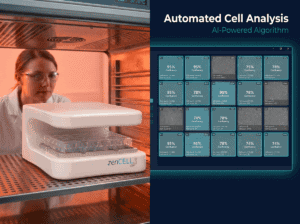
Mira la imagen de zenCELL owl en vivo dentro de una incubadora. Disponible.