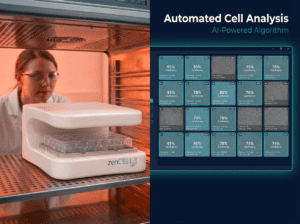
The Lionheart FX is a powerful automated microscope — but at ~$84,000 it significantly overdelivers for labs that only need brightfield cell culture monitoring. zenCELL owl delivers exactly what most labs need, at over 80% lower cost.
Confluency, migration, cytotoxicity, spheroids — no fluorescence required, 24 simultaneous wells, in-incubator, from €14,000. No annual fees.
Multi-channel fluorescence, integrated plate reading, high-content screening and Gen5 assay library are core to your workflow.
An honest specification-by-specification comparison. The Lionheart FX is an excellent instrument — but most of its capabilities are not needed for standard brightfield cell culture monitoring.
| Feature | zenCELL owl | BioTek Lionheart FX |
|---|---|---|
| Purchase price | from €14,000 | ~$84,000 |
| Annual software licence | None — included | Yes — Gen5 |
| Service contract | Not required | Recommended · extra cost |
| Rental option | ✓ from €290/month | ✗ Not available |
| Imaging mode | Brightfield only | Brightfield + Fluorescence + Phase |
| Simultaneous wells | 24 — all at once | Sequential — 1 position at a time |
| Camera resolution | 5MP | 1.25MP |
| In-incubator use | ✓ Designed for it | ✗ External device |
| Footprint | 18×18×10 cm · 1.5 kg | Large benchtop instrument |
| ImageJ integration | ✓ Free | ✗ Gen5 proprietary only |
| Open API / data export | ✓ CSV, PNG, AVI | ✗ Proprietary formats |
| 96/384-well support | ✓ XYZ stage add-on | ✓ Standard |
| Publications | >50 | >200 |
| Free trial / demo | ✓ Remote + 2-week lab trial | On request |
The BioTek Lionheart FX combines automated microscopy with an integrated plate reader — supporting multi-channel fluorescence, luminescence and absorbance measurements in one system. Furthermore, the Gen5 software library includes validated assay protocols for hundreds of fluorescence-based applications. If your lab depends heavily on fluorescence imaging and integrated plate reading, the Lionheart FX is the more capable instrument for those specific needs.
Both systems are legitimate live cell imaging platforms. The right choice depends entirely on your assay requirements and budget.
These are the applications most labs actually run day-to-day. All work with brightfield. All work better when your device lives inside the incubator with your cells.
Automated growth curves across 24 wells simultaneously. AI confluency measurement at every time point — no manual counting, no incubator opening.
Automated gap closure analysis with standardised scratch width. High-precision migration rate data for all 24 wells in parallel — publication-ready.
Continuous kinetic drug response data throughout the entire assay. IC50 determination without endpoint assays — real-time morphology and viability changes.
Monitor spheroid growth and compaction for up to 2 weeks. Automated timelapse videos per well — undisturbed, inside the incubator throughout.
XYZ stage add-on enables 96 & 384-well live cell imaging. Full 96-well scan in under 90 seconds — continuous monitoring inside the incubator.
Monitor cells under hypoxic conditions without disrupting the incubator environment — impossible with bench-mounted systems like Lionheart FX.
The BioTek Lionheart FX (now part of Agilent Technologies) is an automated digital microscope that combines brightfield, phase contrast and fluorescence imaging with optional plate reader functionality. It is designed as a benchtop laboratory instrument and does not operate inside the incubator. Furthermore, it requires the Gen5 software licence for full functionality — an additional annual cost on top of the ~$84,000 purchase price.
For brightfield-only applications — yes, completely. zenCELL owl delivers higher camera resolution (5MP vs 1.25MP), 24 simultaneous wells vs sequential scanning, in-incubator placement and free ImageJ integration — at over 80% lower cost. Additionally, the rental option from €290/month makes it accessible without a capital purchase. For labs that require fluorescence imaging or integrated plate reading, the Lionheart FX has capabilities that zenCELL owl cannot replicate.
The BioTek Lionheart FX lists at approximately $84,000. However, the Gen5 software licence required for full functionality adds an annual fee, and Agilent recommends a service contract for reliability — further increasing the total cost of ownership. Moreover, consumables for fluorescence assays (dyes, reagents) add ongoing costs that brightfield-only systems like zenCELL owl do not require.
zenCELL owl has a 5MP camera sensor compared to the Lionheart FX's 1.25MP — making zenCELL owl's resolution 4× higher for brightfield imaging. For confluency analysis, migration assays and morphology monitoring, higher resolution enables more accurate automated analysis. Furthermore, zenCELL owl images all 24 wells simultaneously, whereas the Lionheart FX scans sequentially — introducing timing differences between wells in kinetic assays.
Book a free 30-minute remote demo — we will show you zenCELL owl imaging real cells inside an incubator and help you assess whether brightfield is sufficient for your assays.
Watch zenCELL owl image live inside an incubator. Available.