
Zebrafish larvae toxicity monitoring with zenCELL owl tracks morphology, movement, and survival of larvae in multiwell plates inside the incubator — label-free, continuously, without anaesthesia or incubator disruption. Zebrafish larvae are an established alternative to mammalian animal models for toxicology and drug screening, combining genetic tractability with whole-organism complexity.
Zebrafish (Danio rerio) larvae at 72–120 hours post-fertilisation (hpf) are optically transparent, develop rapidly, and share 70% genetic homology with humans. They are used in developmental toxicology, cardiotoxicity screening, neurotoxicity, and environmental contaminant assessment. As vertebrates, they provide physiological relevance that cell culture models lack — while being ethically classified differently from adult vertebrate experiments in most regulatory frameworks.
Larvae are placed in individual wells of a multiwell plate (typically 24-well) with defined water volume and drug concentration. zenCELL owl captures brightfield time-lapse images at user-defined intervals inside the incubator. Morphological endpoints (body axis curvature, pericardial oedema, yolk sac absorption, swim bladder inflation) and movement patterns are visible in brightfield without staining or fluorescence. Survival is monitored continuously from the image series.
No. Because zenCELL owl images from below through the plate without requiring larvae to be immobilised, standard anaesthesia (MS-222 / tricaine) is not needed for imaging sessions. This eliminates anaesthesia-related confounders and allows true behavioural monitoring including spontaneous movement frequency and response to stimuli.
24 larvae per plate (one per well in 24-well format), imaged simultaneously at every timepoint. Multiple plates can be run in sequence. For higher throughput, the zenCELL owl Scan (owl SCAN) variant images 96-well plates in approximately 90 seconds per scan.
Zebrafish larvae are typically cultured at 28°C in E3 embryo medium. zenCELL owl is compatible with incubators set to 28°C. CO₂ is not required for zebrafish larval culture — a standard temperature-controlled incubator is sufficient.
Book a free demo → Discuss zebrafish larval imaging applications for your toxicology research.
 English English
 Deutsch
 Français
 Español
 简体中文 English English Deutsch Français Español 简体中文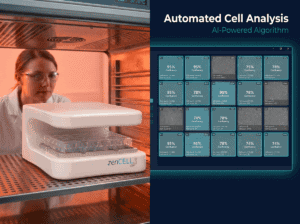
Watch zenCELL owl image live inside an incubator. Available.